Grab-and-Go Document Binder: Exactly What to Include
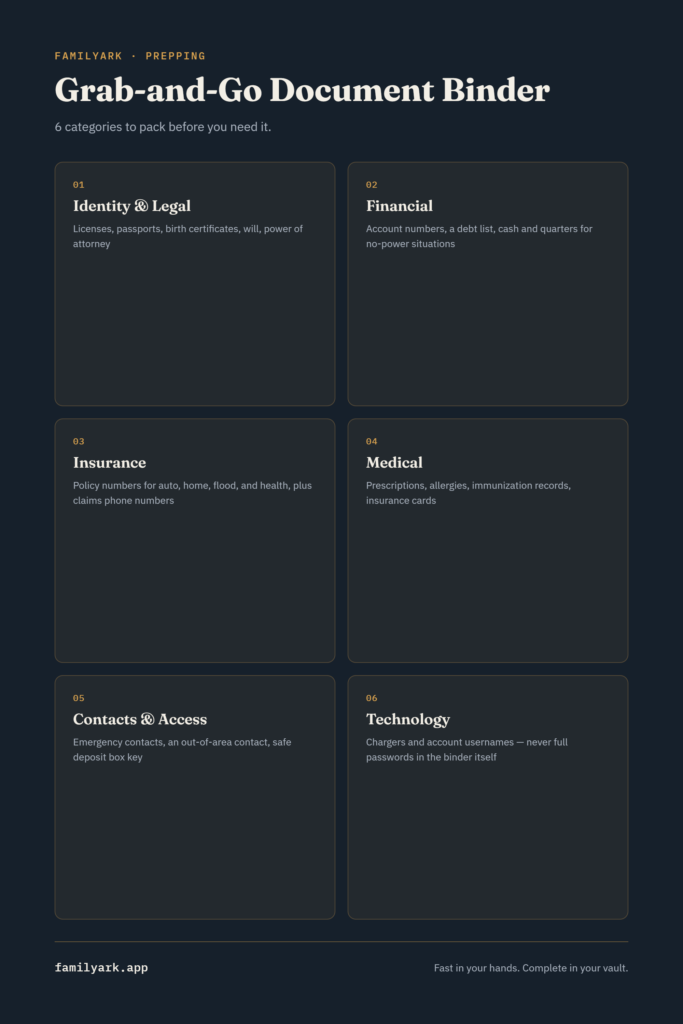
A grab-and-go document binder needs identity documents, financial and insurance information, medical records, legal paperwork, emergency contacts, and a small amount of cash — organized into one slim folder you could genuinely pick up and carry out the door in under a minute. The goal isn’t to duplicate your entire filing cabinet; it’s to have the handful of things you can’t easily replace or quickly access anywhere else, ready before you need them.
Why “before you need it” is the whole point
Evacuation windows are often much shorter than people plan for. Wildfires can move at 6 miles per hour through forest and up to 14 miles per hour through grassland, and that speed is exactly why officials increasingly warn people not to wait for a formal evacuation order if a fire looks like it’s approaching — some of the deadliest wildfire events on record involved warnings that came too late or not at all. The same logic applies to floods, hurricanes, and gas leaks: the moment you’re told to leave is not the moment to start deciding what to grab.
A binder built in advance turns a scramble into a 30-second grab. That’s the entire value of doing this now instead of “eventually.”
The complete checklist, by category
Identity and legal documents
- Driver’s licenses and passports
- Birth, marriage, adoption, and death certificates
- Social Security cards (or at minimum, the numbers written down separately from the cards)
- Will, trust documents, and durable power of attorney
- Child custody or guardianship paperwork, if applicable
Financial information
- A list of bank, investment, and retirement account numbers
- Recent statements or account summaries
- A list of debts, loans, and their due dates
- Some cash and a roll of quarters — ATMs and card readers don’t work without power
Insurance documentation
- Copies or account numbers for auto, home/renters, flood, and health insurance
- A one-page list of every policy you hold and the company’s claims phone number
Medical information
- Copies of current prescriptions
- A list of medications, dosages, and allergies
- Eyeglass or contact lens prescriptions
- Immunization records, especially for children
- Health and dental insurance cards
Contacts and access
- Emergency contacts: doctors, pharmacy, family, and a designated out-of-area contact
- Insurance company claims numbers
- Safe deposit box location and key (or the key itself, if it’s small enough)
Technology
- Phone, tablet, and laptop chargers
- A written list of important account usernames — never the passwords themselves in an unencrypted binder (more on that below)
What to leave out
The binder works because it’s slim enough to actually grab. Resist the urge to include:
- Photo albums or sentimental items — these belong in a separate, secondary “if there’s time” list, not the primary binder
- Full account passwords in plain text — a binder that gets lost or stolen becomes a security risk, not just an inconvenience. Write down which accounts exist, not how to log into them.
- Anything you’re not prepared to have a stranger see if the binder is ever lost. Assume it will eventually be handled by more people than just you.
How this fits with the rest of your setup
A grab-and-go binder is the physical, fast-access piece of a larger system — it’s not meant to replace a complete digital record. The full document checklist covers everything you’d want organized long-term, and the binder-vs-app comparison goes deeper on why pairing physical and digital matters — a grab-and-go binder is fast in the moment, but it’s also just as vulnerable to being left behind, lost, or damaged as any other piece of paper. The complete, current version of everything should also exist somewhere encrypted and digital, so that even if the binder never makes it out the door with you, nothing is actually lost.
For the account and password list specifically, this is exactly the situation an encrypted local vault is built for: a place to record which accounts exist and how to reach them, without ever writing the actual login credentials into a folder that could physically leave your possession.
A simple weekend plan
- Get a slim accordion folder or a binder with a handle — something you could pick up one-handed while also carrying a bag.
- Print or photocopy the identity, legal, insurance, and medical documents listed above.
- Write out the financial and account lists — numbers and institutions, never full passwords.
- Add cash and chargers, and store the binder somewhere near an exit, not buried in a closet.
- Set a reminder every six months to swap in updated documents and refresh the cash.
Frequently asked questions
How big should this binder actually be? Small enough to grab in one hand along with a go-bag. If it’s bulky enough that you’d hesitate before running for it, it’s too big — trim it down to true essentials.
Should I keep this somewhere outside the house too? A duplicate set with a trusted family member or in a small fireproof lockbox at a second location is a smart extra layer, especially for the identity and legal documents that are hardest to replace.
What about our pets’ records? Worth adding if you evacuate with animals — vaccination records and a recent photo can matter for shelters, boarding, or proving ownership if you’re separated.
Is it safe to put account passwords in this binder? No — write down which accounts and institutions exist, not the passwords themselves. A lost or stolen binder with your actual logins in it turns an inconvenience into identity theft. Keep the passwords in an encrypted vault instead, and use the binder just to point to where that vault is and how a trusted person could access it.