The Go-Bag “Luxuries” That Are Actually Worth Packing
A little comfort in a crisis isn’t indulgence — it’s function. A fresh pair of socks after hours in wet boots, a familiar snack when you’re running on adrenaline, something to do with your hands while you wait out an evacuation shelter: none of that changes whether you survive, but it changes whether you’re steady enough to make good decisions once the adrenaline wears off. The mistake isn’t packing comfort items. It’s packing your worst version of everything and calling it prepping.
The “good enough” trap
A lot of go-bags get built the same way: the stuff that’s too worn out for daily life gets demoted to “emergency use” instead of thrown out. Stretched-out socks, a stained t-shirt, a bar of soap down to a sliver — none of it’s actively broken, so it feels responsible to keep it around for a day you hope never comes.
But that logic backfires exactly when it matters most. If you ever have to grab that bag and go, you’re already having the worst day in recent memory — cold, wet, scared, or just exhausted from helping other people get out. That’s not the moment to hand yourself the worst version of your own stuff. It’s the moment a warm, dry pair of socks you’d actually choose to wear does more for you than it has any right to.
The fix isn’t spending more. It’s packing things you’d genuinely use on a normal day, not the stuff you were about to throw away anyway.
What’s worth the extra weight
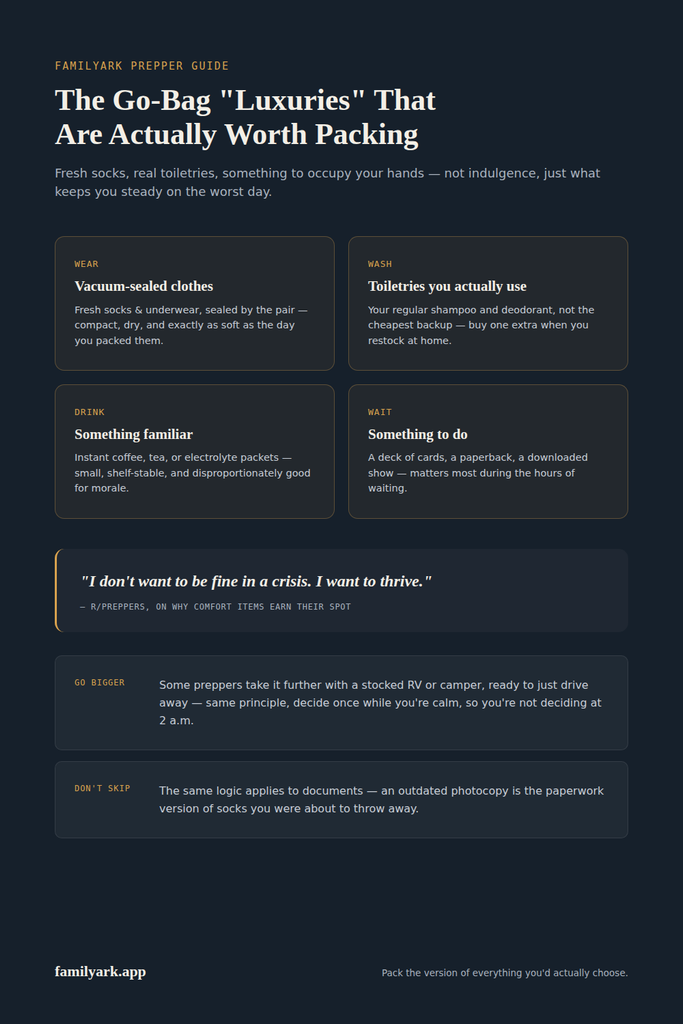
- A full change of clothes you’d actually wear. Not your softest jeans (broken-in is fine, even good, for pants and boots) — but at minimum, fresh socks and underwear. Vacuum-sealed by the pair, they take up almost no room and come out exactly as soft and dry as the day you packed them, however long they’ve been sitting in the bag.
- Toiletries you actually use, not the cheapest version. Your regular shampoo, a real toothbrush, deodorant — the brand you’d buy anyway, bought one extra of and rotated in when you replace the one at home. It costs nothing beyond what you were going to spend either way.
- Something familiar to eat or drink. Instant coffee packets, tea bags, or the electrolyte packets that make plain water bearable — small, shelf-stable, and disproportionately useful for morale when everything else about the day is unfamiliar.
- Something to occupy your hands or your head. A deck of cards, a paperback, a downloaded show on a phone or tablet — cheap, weighs nothing, and matters more than it sounds like it should during the hours of waiting that make up most of an actual evacuation.
- A dry pair of shoes, if you have room. Not a luxury so much as a second system — wet feet for hours is how minor discomfort turns into a real injury.
None of this is about buying gear you don’t already own. It’s about not being the one making the call to grab your worst version of all of it.
The bigger version of the same idea: a vehicle that’s already ready
Some people take this a step further with an RV or camper kept stocked, fueled, and ready to just drive away in — no packing, no decisions, no scrambling to load a vehicle while a fire or storm closes in. It’s a bigger investment than vacuum-sealed socks, but it’s the same underlying logic: decide once, while you’re calm, what “ready” looks like, so that on the day it matters you’re not making those decisions from scratch.
You don’t need a camper for the principle to apply. A duffel of seasonally-appropriate clothes and the supplies from this list, kept in the vehicle you already drive, gets you most of the same benefit — a “grab it and go” kit that doesn’t depend on remembering what to pack at 2 a.m.
The maintenance this approach requires
Comfort items aren’t “set it and forget it” any more than the rest of your kit. A couple of things worth building into your regular rotation:
- Elastic degrades in heat. Underwear and anything with elastic waistbands can lose their stretch after a summer in a hot trunk. If your bag lives in a vehicle, check it — or swap to a seasonal kit that isn’t sitting through 120-degree afternoons.
- Rotate seasonally, not just for freshness. Summer clothes in a winter bag (or the reverse) defeats the purpose. Swap the clothing kit twice a year along with everything else you’re already checking.
- Buy what’s on sale, when it’s on sale. Toiletries and shelf-stable snacks don’t expire quickly — stocking up an extra one or two of what you already use, whenever it’s discounted, keeps this approach essentially free over time.
The same logic applies to your documents
There’s a version of the “worst version of everything” mistake that shows up in document prep too: a photocopy from years ago, stuffed in a folder and never looked at again, that’s technically still there but quietly out of date — an old insurance card, a policy number that’s changed, an ID that’s expired. Just like you don’t want your emergency socks to be the ones you were about to throw away, you don’t want your emergency documents to be the ones you forgot to update.
This is where a digital backup earns its place next to the physical one. FamilyArk keeps your documents encrypted and current on your device, so updating a policy number or swapping in a renewed ID takes a minute instead of a re-print-and-reseal chore you keep putting off. The vacuum-sealed folder in your bag is for the documents you’d need in hand during an evacuation; the vault is what keeps the rest of them actually current, not just technically present.
Frequently asked questions
Isn’t this all just extra weight for a go-bag? A few pairs of vacuum-sealed socks and underwear, some tea or coffee packets, and a deck of cards add close to nothing in weight or space — vacuum sealing in particular compresses clothing down to a fraction of its normal size. The tradeoff is closer to “almost free” than “heavier bag.”
What’s the difference between this and just overpacking? Overpacking is adding more categories of gear you might never use. This is about the quality of what’s already in the categories you’ve already decided to pack — better socks, not more socks.
Should I do this for every bag, or just a car kit? Wherever the bag might sit for a while before you need it — a car, a closet, a bug-out bag — benefits most, since that’s exactly the scenario where “whatever’s in there” is what you’re stuck with. A bag you repack every few days doesn’t need the same treatment.
Is a stocked RV or camper actually a realistic prep, or overkill? It’s a real approach some preppers use, but it’s an expensive one and not a starting point — it makes the most sense as something you build toward after the basics (a solid go-bag, documents, a plan) are already handled, not instead of them.
See task progress for longer tasks.luxury-go-bag-pin.pngluxury-go-bag-items.mdvacuum-seal-pin.pngvacuum-sealing-go-bag.mdspouse-dies-pin.pngwhat-to-do-first-when-a-parent-dies.mdwhat-to-do-when-a-spouse-dies.mdquick-go-bag-pin.pngquick-go-bag.mdchristmas-gift-prepper-pin.pngchristmas-gift-ideas-prepper.docxpinterest-pin-kit.mdchristmas-gift-ideas-prepper.mdpartner-outreach-email-kit.mdfamilyark-vs-docvault-arcae-trusted-family.md