What to Do When a Spouse Dies: A Document Checklist
There’s no good way to make this easier, and nothing here is meant to rush you through it. But at some point, in the first days and weeks, the practical side needs handling — and losing a spouse comes with paperwork a parent’s death usually doesn’t: joint accounts, survivor benefits, and your own health coverage among them. This is a clear list of what’s actually needed, in order, so that part is at least easier to carry.
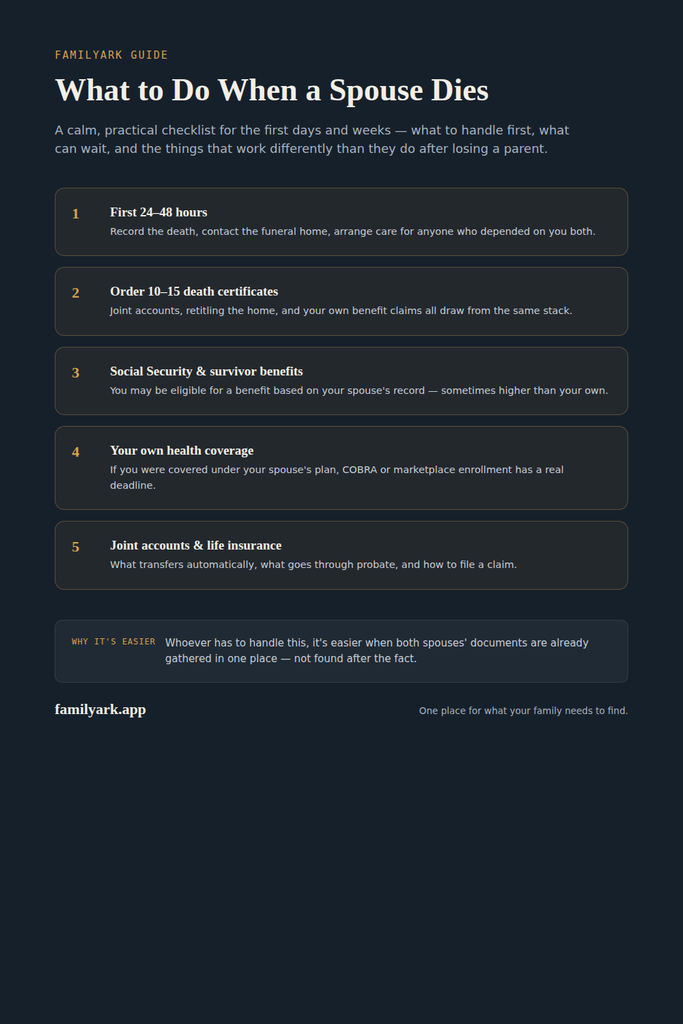
The first 24–48 hours
Nothing here needs to happen this hour except the first item — everything else can wait a day if you need it to.
- Get the death officially pronounced and recorded. If it happens at home under hospice care, the hospice team handles this. Otherwise, it’s the hospital, or you’ll need to call 911.
- Contact the funeral home or cremation provider. They’ll typically handle transportation and begin requesting a death certificate on your behalf.
- Arrange care for anyone who depended on you both — children, pets, or anyone else in the household.
- Notify close family first, then let them help reach the wider circle of friends, employer, and community.
Order more death certificates than feels necessary
This is the detail almost everyone underestimates, and it hits differently for a spouse than for a parent, because your name is likely on far more of what needs to change. Certified copies are required by nearly every institution you’ll deal with, and most keep the copy rather than returning it. Funeral homes typically handle the initial order — the general guidance is 10 to 15 certified copies for a spouse, a bit more than the usual advice for other family members, since joint accounts, retitling a home, and your own benefit claims all draw from the same stack. Certified copies run about $10–25 each depending on the state — cheaper to order extra now than to pay for expedited shipping later.
Certified copies get used by: banks and credit unions (for every joint account), life insurance providers, the Social Security Administration, the county for retitling a jointly owned home or vehicle, your spouse’s employer for final pay and benefits, and any pension or retirement plan administrator.
The first 1–2 weeks
This is the heaviest stretch, and it’s fine to spread it across two weeks rather than trying to do it all at once.
- Contact the Social Security Administration (800-772-1213). This matters more here than almost anywhere else on this list: as a surviving spouse, you may be eligible for a one-time death benefit and, depending on your age and circumstances, survivor benefits based on your spouse’s earnings record — sometimes higher than what you’d receive on your own record. SSA needs to be notified regardless, to stop future payments to your spouse.
- File life insurance claims. If your spouse carried a policy naming you as beneficiary, most insurers can begin processing a claim within days of receiving a certified death certificate and a completed claim form.
- Look into your own health coverage. If you were covered under your spouse’s employer plan, you’ll need to act on COBRA continuation or a marketplace plan within a specific enrollment window — this is one of the few items on this whole list with a hard deadline that affects you directly, so it’s worth prioritizing over things that only affect the estate.
- Locate the will and any trust documents. If you worked with an estate attorney together, that firm may already have copies on file.
- Start the probate process if needed — usually submitting the will to the local probate court with a certified death certificate. Many assets held jointly with right of survivorship pass to you automatically without probate; an estate attorney can tell you quickly what applies to your specific situation, since it varies by state and by how each asset was titled.
The first 1–3 months
Less urgent, but each has a real cost if ignored too long.
- Retitle joint accounts and property. Banks, brokerages, the home, and vehicles titled jointly typically transfer to the surviving spouse, but each institution has its own process and paperwork.
- Contact all insurance providers — home, auto, umbrella — to update policies now in your name alone.
- Alert the three credit bureaus (Equifax, Experian, TransUnion) to prevent identity theft using your spouse’s information.
- Cancel subscriptions and recurring services billed to accounts that were solely your spouse’s.
- Update your own beneficiary designations and will. It’s easy to overlook, but many people still have their spouse listed as primary beneficiary on retirement accounts, life insurance, and their own will — worth updating once you’re ready.
- Check retirement accounts for required distributions. Inherited IRA rules differ for a spouse than for other beneficiaries, usually with more flexible options — a plan administrator or accountant can walk you through what applies.
The document checklist: what you’ll actually be asked for
Across all of the above, the same handful of documents get requested over and over. Gathering these early makes everything downstream move faster:
- Certified death certificates (multiple copies)
- The will and any trust documents
- Marriage certificate
- Your spouse’s Social Security number and birth certificate
- Recent joint and individual tax returns
- Bank, investment, and retirement account statements
- Life, home, and auto insurance policies
- Property deeds and vehicle titles
- A list of debts, loans, and recurring bills
This is close to the same list covered in what to do first when a parent dies, and for the same reason: whoever has to handle this, the paperwork is easier when it’s already gathered in one place rather than scattered across drawers and old email accounts. For a spouse especially, where so much of this is jointly held, having both of your documents organized together ahead of time — not just found after the fact — is what actually saves the weeks of searching.
That’s the situation FamilyArk is built for: an encrypted, local vault where both spouses’ documents and account information already live in one place, with a plan for how the surviving spouse gets in when it’s needed. It doesn’t replace an attorney or the paperwork itself, but it removes the “where do we even start looking” problem at the exact moment you have the least capacity to deal with it.
Frequently asked questions
Do I need a lawyer right away? Not immediately, but soon — especially if there’s real estate, a business, or an estate above a modest size involved. Many estate attorneys offer a free or low-cost initial consultation just to tell you whether probate is required and what applies to jointly held assets in your state. This isn’t legal advice; treat it as a prompt to get a professional’s read on your specific situation early.
Will I get my spouse’s Social Security benefit, or my own? Generally whichever is higher, not both. If your spouse’s benefit was larger than yours, you can typically switch to a survivor benefit at full retirement age or earlier at a reduced rate — the Social Security Administration can walk you through the specific numbers for your situation.
What happens to accounts that were only in my spouse’s name? These typically go through the estate rather than transferring automatically, which usually means probate. This is a meaningful difference from jointly titled accounts, and it’s worth flagging early to whoever is helping you with the paperwork.
What can wait until I’m ready? Sorting through personal belongings, closing social media accounts, and updating your own will can generally wait weeks or months. Prioritize anything with a legal deadline or an ongoing cost first — health coverage and Social Security notification matter more early on than most of what’s on this list — and give yourself permission to handle the rest when you have the bandwidth for it.