What to Do First When a Parent Dies: A Document Checklist
There’s no version of this that isn’t hard, and nothing here is meant to rush you through it. But at some point in the first days, someone has to start handling the practical side — and having a clear list of what’s actually needed, in order, makes that part easier to carry. This is that list: what to do first, what documents to gather, and what can wait.
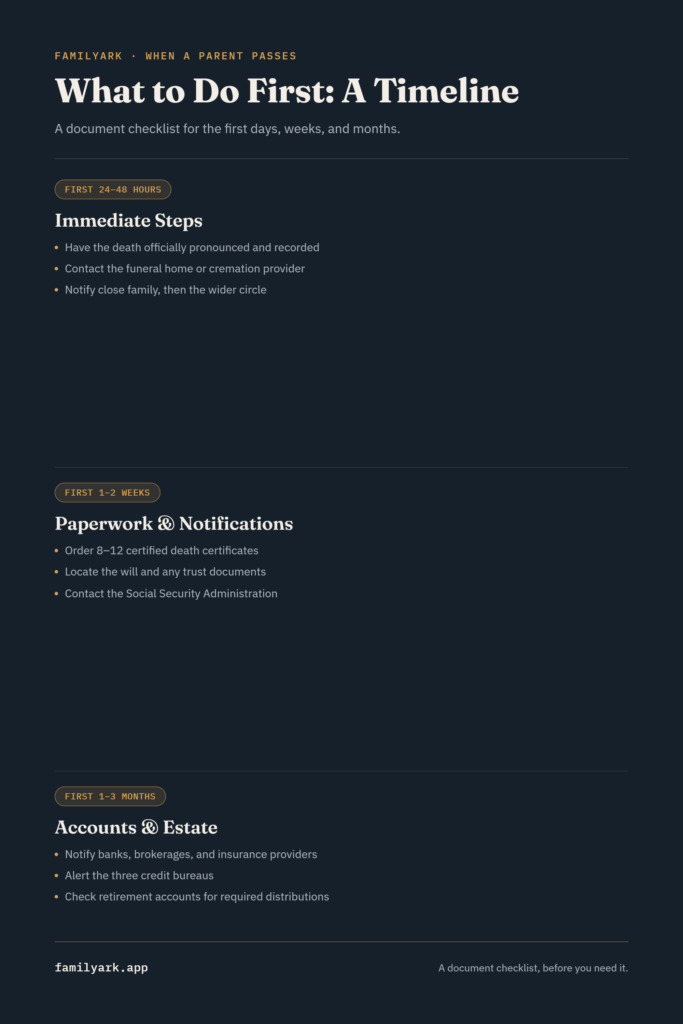
The first 24–48 hours
Nothing on this list is urgent in the sense of “must happen this hour” except the first one — everything else can wait a day if you need it to.
- Get the death officially pronounced and recorded. If death occurs at home under hospice care, the hospice team handles this. Otherwise, it’s the hospital, or you’ll need to call 911.
- Contact the funeral home or cremation provider. They’ll typically handle transportation and begin the process of requesting a death certificate on your behalf.
- Arrange care for anyone who depended on your parent — a spouse who needs support, pets, or dependents.
- Notify close family first, then let them help with the wider circle of friends, employer, and community.
Order more death certificates than feels necessary
This is the detail almost everyone underestimates. Certified copies of the death certificate are required by nearly every institution you’ll deal with, and most of them keep the copy rather than returning it. Funeral homes typically handle the initial order, and the general guidance is 8 to 12 certified copies — the exact number depends on how many accounts, properties, and policies your parent had. It’s cheaper to order a few extra up front (usually $10–25 each depending on the state) than to pay for expedited shipping on a second batch three weeks later when a bank asks for one you don’t have.
Certified copies get used by: banks and credit unions, life insurance and pension providers, the Social Security Administration, county offices for property transfers, and stock or brokerage firms — each one keeps its own copy.
The first 1–2 weeks
This is the heaviest stretch of paperwork, and it’s fine to spread it across the two weeks rather than trying to do it all at once.
- Locate the will and any trust documents. If your parent worked with an estate attorney, that firm may already have copies on file — worth a call before you tear the house apart looking.
- Contact the Social Security Administration (800-772-1213). A surviving spouse or dependent children may be eligible for a one-time death benefit, and SSA needs to be notified regardless to stop future payments.
- Check with the employer if your parent was still working, about any retirement plan, final paycheck, or continued health coverage (COBRA) for a surviving spouse.
- Forward the mail. USPS mail forwarding for a deceased person requires proof that you’re the executor or a legal representative.
- Start the probate process if needed — this usually means submitting the will to the local probate court along with a certified death certificate. An estate attorney can tell you quickly whether probate is required for your parent’s specific situation, which varies a lot by state and by how assets were titled.
The first 1–3 months
Less urgent, but each of these has a real cost if it’s ignored too long.
- Notify banks and brokerages and begin the process of retitling or closing accounts.
- Contact all insurance providers — life, home, auto — both to file claims and to keep policies active where needed.
- Alert the three credit bureaus (Equifax, Experian, TransUnion) to prevent identity theft using a deceased person’s information, which is unfortunately common.
- Cancel subscriptions and recurring services billed to your parent’s accounts.
- Check retirement accounts for required distributions. Inherited IRAs have specific rules and deadlines — an accountant or the plan administrator can tell you what applies.
The document checklist: what you’ll actually be asked for
Across all of the above, the same handful of documents get requested over and over. If you can gather these early, everything downstream moves faster:
- Certified death certificates (multiple copies)
- The will and any trust documents
- Social Security number and birth certificate
- Marriage certificate (if a surviving spouse is filing for benefits)
- Recent tax returns
- Bank, investment, and retirement account statements
- Insurance policies (life, home, auto)
- Property deeds and vehicle titles
- A list of debts, loans, and recurring bills
If any of this sounds familiar, it’s the same list from organizing a family’s important documents in the first place — which is exactly why that groundwork pays off the most in a moment like this one. Families who’ve already gathered these into one place spend this stretch making phone calls, not searching through filing cabinets and old email accounts trying to reconstruct where everything is.
That’s the situation FamilyArk is built for: an encrypted, local vault where a parent’s documents and account information already live in one organized place, with a plan for how a trusted family member gets in when it’s needed. It doesn’t replace an attorney or the paperwork itself, but it removes the “where do we even start looking” problem entirely.
Frequently asked questions
Do I need a lawyer right away? Not immediately, but soon — especially if there’s a will to probate, real estate involved, or the estate is more than a modest amount. Many estate attorneys offer a free or low-cost initial consultation just to tell you whether probate is required and what the timeline looks like in your state. This isn’t legal advice; treat it as a prompt to get a professional’s read on your specific situation early rather than late.
What if my parent didn’t leave a will? The estate is handled under your state’s “intestate succession” laws, which determine who inherits and often require a court-appointed administrator. It’s more complex and typically slower than an estate with a will, which makes talking to a probate attorney early even more worthwhile.
How soon do I need to notify Social Security? As soon as reasonably possible — funeral homes often report the death to SSA automatically, but it’s worth confirming rather than assuming. Overpaid benefits after a death sometimes have to be returned, so timeliness matters here more than with most other notifications.
What can wait until I’m ready? Sorting through personal belongings, closing social media accounts, and canceling smaller subscriptions can generally wait weeks or months. Prioritize anything with a legal deadline or an ongoing cost first, and give yourself permission to handle the rest when you have the bandwidth for it.